Underarm waxing: professional technique, preparation and aftercare
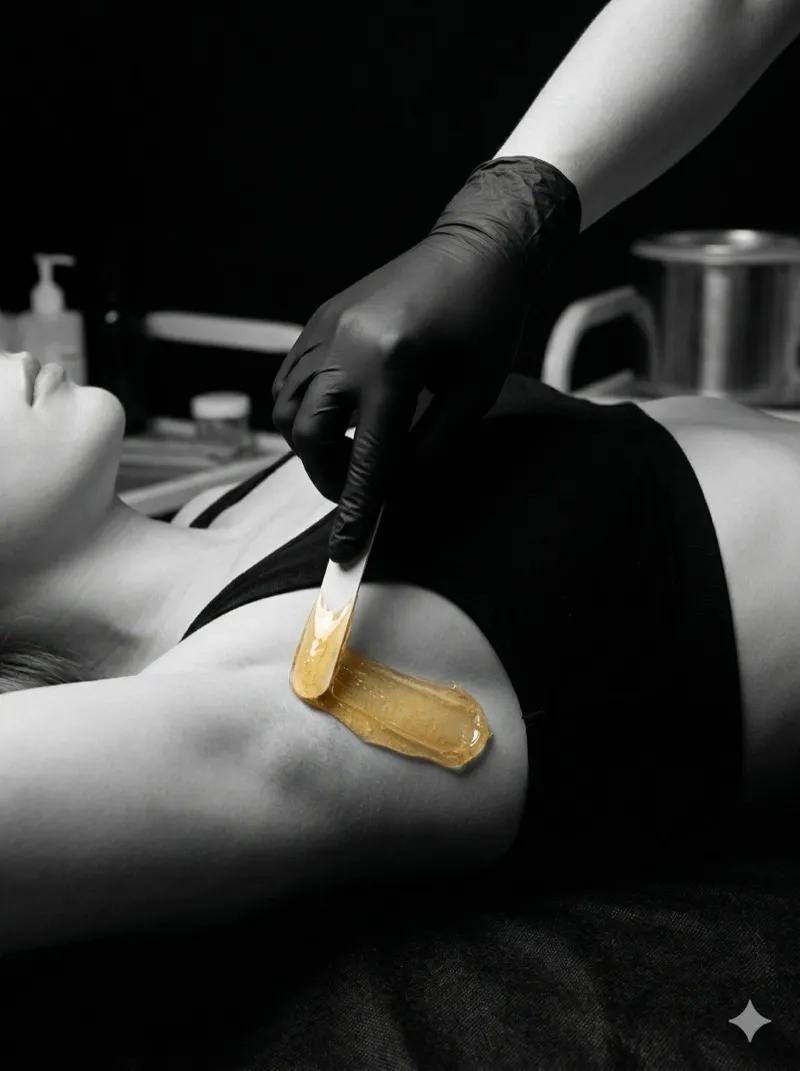
Underarm waxing removes hair from the root, leaving your skin smooth for 3 to 5 weeks – compared with the 2–3 days you get from shaving.
An underarm wax removes hair from the root, leaving your skin smooth for 3 to 5 weeks – compared with the 2–3 days you get from shaving. It's one of the most popular treatments in any beauty salon, because it's quick – around 10–15 minutes – and you see the results from the very first session. In this guide you'll find everything you need to know before, during and after your appointment: from how to prepare your skin to the aftercare routine that prevents bumps and irritation.
What is underarm waxing?
Waxing means applying a layer of hot or warm wax to the underarm and removing it with a firm pull against the direction of hair growth. Because the hair is pulled out from the follicle, the skin is left completely free of visible hair and, with regular sessions, the hair grows back finer and weaker each time.
For underarms we usually use low-melt hot wax (also known as "peel-off" or stripless wax) rather than warm wax with strips. The reason is practical: hot wax grips the coarse underarm hair better and the skin less, which means less pulling and less irritation on such a sensitive area.
Benefits of underarm waxing
- Results that really last: 3 to 5 weeks without visible hair, depending on your growth cycle.
- Hair weakens over time: session after session, the hair grows back finer and sparser, so each appointment is quicker and more comfortable.
- No cuts or micro-injuries: unlike a razor, wax doesn't cause tiny cuts that can get infected or lead to folliculitis.
- Built-in exfoliation: as the wax comes off, it takes dead skin cells with it, leaving your skin softer to the touch.
- Effective on coarse hair: underarm hair is dense and dark, and wax removes it easily – something other methods, such as hair removal creams, can't always manage in one go.
Comparison: wax vs shaving vs hair removal creams
| Criterion | Hot wax | Shaving | Hair removal cream |
|---|---|---|---|
| How long results last | 3-5 weeks | 1-3 days | 5-10 days |
| Pain | Moderate (decreases with sessions) | None | None |
| Risk of folliculitis | Low | High | Medium |
| Effect on hair thickness | Weakens it | No change | No change |
| Skin darkening | Minimal | Common due to irritation | Possible due to chemicals |
| Time in the treatment room | ~10-15 min | — | — |
Shaving is still the quickest option at home, but for underarms it has one specific drawback: the hair grows in several directions, which easily leads to ingrown hairs. Because wax removes hair from the root, it largely avoids that problem.
Preparation: the keys to a successful wax
Good preparation is the difference between a comfortable session with a flawless result and an uncomfortable experience with irritation afterwards. These steps apply whether it's your first time or you're already used to having your underarms waxed.
Skin care before your appointment
- Hair length: the hair should be between 0.5 and 1 cm long (roughly the length of a grain of rice). Any shorter and the wax can't grip it properly; any longer and the pull is more uncomfortable. Allow about 2–3 weeks without shaving before your appointment.
- Gentle exfoliation: two days before your session, exfoliate your underarms in the shower with a soft mitt or a fine-grain scrub. This removes dead skin cells and frees any hairs trapped under the surface.
- Daily moisturising: keep your skin moisturised in the days beforehand, but don't apply cream or deodorant on the day of your appointment. The wax needs to grip the hair, and product residue gets in the way.
- Avoid direct sun: don't sunbathe or use a sunbed on the area for at least 48 hours before. Skin that's irritated or red from the sun is more sensitive and more likely to react.
- No retinoids or acids: if you use products containing retinol, AHA or BHA on the area (unusual for underarms, but worth mentioning), stop using them 5–7 days before.
Timing: when is the best time to wax?
If you're planning for a specific event – a wedding, a holiday, a party – book your wax at least 48 hours beforehand. That gives any slight redness plenty of time to disappear completely.
As for your menstrual cycle, sensitivity to pain is usually higher in the days before and during your period. If you find your pain threshold is lower on those days, book your appointment for the week after your period.
If you're new to underarm waxing at Adrian Beauty Studio Gandia or at Adrian Beauty Studio Ontinyent, the usual approach is to start with a trial session and then space the following ones every 4–5 weeks.
Professional underarm waxing technique
The difference between waxing at home and going to a beauty salon isn't just comfort: it's the removal technique, the type of wax and temperature control – all of which reduce pain, irritation and the risk of burns.
The process step by step
- Cleansing and disinfecting: the therapist cleans the area with an antiseptic pre-wax lotion that removes oil, leftover deodorant and bacteria. This lowers the risk of post-wax folliculitis.
- Applying talc or pre-wax powder: a fine layer of talc absorbs any remaining moisture and creates a barrier between the wax and the skin. The result: the wax sticks to the hair, not the skin.
- Temperature test: before it goes anywhere near the underarm, the wax temperature is checked on the inside of the wrist. This step is a must in any professional salon.
- Applying the wax: the hot wax is spread with a spatula in the direction of hair growth, in small sections. Underarm hair grows in several directions (usually two or three), so the area is worked section by section.
- Setting time: the wax is left to set for 10 to 30 seconds (depending on the type and brand of wax) until it's flexible but firm.
- Removal: with a quick movement parallel to the skin, the wax is pulled off against the direction of growth. The therapist holds the skin taut with her other hand to minimise pulling.
- Tidying up: any stray hairs are removed individually with tweezers. The same area is never waxed more than twice in one session, to avoid irritating the skin.
- Aftercare application: a soothing after-wax oil or gel – usually with aloe vera, azulene or bisabolol – is applied to remove wax residue and calm any immediate redness.
The whole process takes around 10–15 minutes per underarm. If your hair is very long (more than 1.5 cm), mention it when you book so it can be trimmed before the wax goes on.
Wax temperature and safety precautions
Hot wax melts at between 37 °C and 45 °C, depending on the formula. A professional heater with a digital thermostat keeps the wax at exactly the right temperature throughout the session – something you simply can't replicate with a microwave at home.
A poorly controlled temperature brings two main risks: burns (wax that's too hot) and poor results (wax that's too cool, doesn't grip and has to be reapplied). In a professional beauty salon, the heater is calibrated daily and the temperature is tested before every application.
Important: if you have a history of burns, keloid scars or heat sensitivity in the area, tell your therapist before you start. She can adjust the type of wax or the technique.
Professional removal technique
The removal pull follows specific mechanics that are learnt through training and practice:
- Angle: the wax is removed at a 180° angle (parallel to the skin), never upwards. Pulling upwards hurts more and can snap the hair instead of removing it from the root.
- Speed: the movement should be quick and continuous. A slow or hesitant pull hurts more and removes less hair.
- Skin tension: with her free hand, the therapist stretches the skin in the opposite direction to the pull. For the underarm, this means you'll keep your arm raised and slightly back.
- Direction by section: as underarm hair grows in two or three different directions, the therapist mentally divides the underarm into sections and adapts the direction of application and removal to each one.
This professional technique is the main reason why underarm waxing in a salon is more effective and less painful than doing it at home. To find out more about professional technique on other areas, see our complete guide to waxing methods.
Aftercare: essential care afterwards
What you do after waxing has as much impact on the result as the technique itself. A good aftercare routine prevents bumps, irritation, dark marks and ingrown hairs. If you're after a quick reference, we have an aftercare guide specifically for underarms.
The first 24–48 hours after waxing
- Don't use deodorant containing alcohol, or antiperspirant, for at least 24 hours. The pores are open, and any product with fragrance or alcohol can sting and cause irritation. If you need something, choose a natural alum stone or a fragrance-free deodorant.
- Avoid extreme heat: no sauna, steam room, very hot water or intense exercise for the first 24 hours. Sweat in open pores is a recipe for folliculitis.
- Don't touch the area: your hands carry bacteria. Try not to scratch or touch your underarms, even if they feel a little sensitive.
- Loose clothing: on the first day, wear loose cotton tops that don't rub the area. Tight synthetic fabrics trap moisture and heat.
- No pool or beach: chlorine and salt irritate freshly waxed skin. Wait at least 48 hours.
Long-term maintenance routine
Between waxes, these habits keep your skin smooth and help prevent the dreaded ingrown hairs:
- Weekly exfoliation: from the third day after waxing, exfoliate your underarms once or twice a week with an exfoliating mitt or a gentle scrub. This stops new hair getting trapped under the skin.
- Daily moisturising: apply a fragrance-free moisturiser after your shower. Formulas with aloe vera or shea butter work well for this area.
- No shaving between sessions: if you spot stray hairs before your next appointment, resist the urge to reach for the razor. Shaving cuts the hair at the surface and cancels out the weakening effect of waxing. If a hair really bothers you, pluck it with tweezers.
Recommended aftercare products
You don't need an expensive routine. These basics cover everything you need:
- Pure aloe vera gel (at least 90%): soothes, moisturises and has natural anti-inflammatory properties. It's the perfect all-rounder for the first few hours.
- Rosehip or jojoba oil: for moisturising in the days that follow. Both are non-comedogenic, so they won't clog pores.
- Serum or lotion with 1–2% salicylic acid: from the third day, it helps prevent ingrown hairs by keeping pores clear. Don't use it within 72 hours of waxing.
- Natural alcohol-free deodorant: look for formulas with bicarbonate or mineral salts and no artificial fragrance for everyday use between sessions.
How often should you wax your underarms?
The ideal frequency depends on your hair growth cycle, but the general recommendation is every 4 to 6 weeks. As you build up regular sessions, it's common for the gap to get gradually longer.
Hair growth cycle and how long results last
Body hair goes through three phases: anagen (active growth), catagen (transition) and telogen (rest and shedding). Wax only removes hairs in the anagen phase effectively, and these make up roughly 30–40% of the total at any one time.
That's why, after waxing, not all the hair grows back at once. Typically:
- Weeks 1–2: completely smooth skin.
- Week 3: the first fine hairs appear (the ones that were in the telogen phase at your appointment).
- Weeks 4–5: enough new hair for another session.
With regular sessions, more and more follicles fall into sync, which means longer-lasting results and less painful sessions. It's a cumulative effect you'll notice from the third or fourth appointment.
Personalised advice by skin type
- Sensitive or atopic skin: space sessions a little further apart (every 5–6 weeks) and use low-temperature wax with soothing ingredients such as azulene or calendula. Always let your therapist know before starting.
- Combination or normal skin: the standard 4–5 weeks works perfectly.
- Coarse, dark hair: may need more frequent sessions at first (every 3–4 weeks) until the hair has weakened enough.
- Skin prone to pigmentation: avoid the sun between sessions and use SPF50 if the area is exposed.
Whether you visit us in Ontinyent or in Gandia, your therapist will assess your skin and hair type at the first session and suggest a personalised schedule.
Alternative methods: a full comparison for underarms
Wax isn't the only option. Here's an honest comparison of the main alternatives, focused specifically on the underarm area.
Laser vs wax for underarms
Laser offers semi-permanent results (a 70–90% reduction in hair after 6–8 sessions), but it has its limits: it works best on dark hair and fair skin, it needs several spaced-out sessions and it costs considerably more overall. It also requires strict sun protection on the treated area.
Wax is ideal if you want immediate results without a long-term commitment, if you're on a tight budget or if your skin and hair combination isn't ideal for laser. Have a look at our detailed comparison of waxing and laser to see which option suits you best.
Shaving vs wax: differences and benefits
Shaving is free and quick, but for the underarms it has some specific drawbacks:
- The hair grows in several directions, which increases the risk of cuts and razor irritation.
- Underarm skin is thin and creased – tricky territory for a razor.
- Frequent shaving can darken the skin over time because of chronic friction and irritation.
- Ingrown hairs are much more common with shaving than with waxing.
That said, shaving can be an occasional stopgap if you need a quick fix between waxes. Just try not to shave in the week before your waxing appointment, so the hair is long enough.
Hair removal creams vs wax
Hair removal creams dissolve the keratin in the hair using chemicals (usually calcium thioglycolate). They're painless, but have their limits on the underarms:
- Prolonged contact with a damp, sensitive area can cause chemical irritation or contact dermatitis.
- They don't remove the hair from the root, so results don't last as long (5–10 days).
- They leave a lingering chemical smell, which can be unpleasant on an area so close to your nose.
They're fine in an emergency, but they don't replace the cumulative benefits of regular waxing.
Threading vs wax for underarms
Threading is common for eyebrows and the upper lip, but it isn't recommended for underarms. The reason is simple: the underarm is a large, curved and uneven surface with coarse hair growing in several directions. Threading works hair by hair or in very small sections, which would turn the session into a very long and unnecessarily painful process. For larger areas of the body, wax is more efficient in terms of both time and results.
Underarm waxing for men
Underarm waxing isn't just for women. More and more men are choosing to have their underarms waxed, whether for appearance, for comfort when playing sport or simply to reduce sweating and odour.
The process is exactly the same. The only difference is that men's hair is usually coarser and denser, which may mean an extra pass or a wax with stronger grip. The session may take a couple of minutes longer, but the results are just as good.
If you're interested in waxing more areas, take a look at our guide to full body waxing for women or to body waxing for men, which go through the process area by area.
Frequently asked questions about underarm waxing
Does underarm waxing hurt?
The first session is the most intense, because the hair is at its thickest and densest. Most clients describe it as a brief, bearable sting lasting less than a second per section. From the second or third session, the discomfort drops noticeably because the hair grows back finer and the follicle weakens. If you have a low pain threshold, let your therapist know: she can press on the area straight after the pull (which blocks some of the pain signal) or use a wax formulated with soothing ingredients such as calendula.
Can I wax my underarms if I have sensitive skin?
Yes – waxing is suitable for sensitive skin as long as the right precautions are taken. The key is to use low-temperature wax, ideally formulated without colophony (a resin that some people are allergic to), together with pre- and post-wax products made for reactive skin. If you have active atopic dermatitis, psoriasis or an open wound on the area, check with your dermatologist first. In the treatment room, we always look at the skin before starting and, if there are any signs of existing irritation, the session can be postponed.
What should I do if my skin is irritated afterwards?
Slight redness and swelling are normal and usually fade within 2–4 hours. If you still have irritation after 24 hours, apply pure aloe vera gel several times a day, avoid any fragranced products and don't use deodorant until your skin has fully calmed down. Cold compresses (a damp cloth soaked in cold water) relieve stinging straight away. If you notice pus-filled spots or weals, or the irritation gets worse after 48 hours, see a healthcare professional to rule out an allergic reaction or infection. Don't try to squeeze the spots: you'll only make things worse.
Is it safe to wax my underarms during pregnancy?
Generally speaking, waxing during pregnancy is considered safe, as it doesn't involve chemicals that are absorbed into the body. However, during pregnancy your skin is often more sensitive and blood flow increases, which can make waxing more uncomfortable and the redness afterwards more noticeable. It's a good idea to check with your obstetrician or midwife before your session, especially in the third trimester. If you decide to go ahead, tell your therapist you're pregnant so she can adapt the wax temperature and technique.
How often can I wax my underarms?
The recommended frequency is every 4 to 6 weeks. Waxing more often brings no extra benefit and can irritate your skin unnecessarily, as the hair won't have reached the minimum length needed (0.5 cm). Over time, as the hair weakens, it's common to move to intervals of 5–6 weeks. The most important thing is to stay regular: consistently spaced sessions give the best cumulative results.
Which products should I avoid after waxing?
For the first 24–48 hours, avoid deodorants with alcohol, strong antiperspirants, perfume sprayed directly on the underarm, scrubs, products containing retinol or acids (AHA/BHA) and self-tan. Also avoid body make-up on the area. In short: the less product that touches freshly waxed skin, the better. From the third day you can gradually go back to your usual routine, starting with the gentlest products.
Underarm waxing in Gandia and Ontinyent: your next step
If you're thinking of trying underarm waxing or want a better experience than you're having now, the first step is to book an appointment with a therapist who can assess your skin and hair type. At our salons in la Safor and la Vall d'Albaida we welcome both regular clients and people trying wax for the first time.
You'll find all the details of our underarm waxing service – including current prices and availability – on the service page. If you'd like to know where we are, here are the details for our Ontinyent salon and our Gandia salon.
And if your underarms are just the beginning and you're thinking about other areas, our complete guide to body waxing will help you plan a full treatment tailored to your needs.
Quick reference: waxing
| Area | Session | Lasts | Pain (1-5) |
|---|---|---|---|
| Classic bikini line | 15-20 min | 3-5 wks | 3-4 |
| Underarms | 10 min | 3-4 wks | 3 |
| Half legs | 20-25 min | 3-5 wks | 2-3 |
| Upper lip | 5 min | 2-3 wks | 3 |
| Eyebrows | 10-15 min | 3-4 wks | 2-3 |
| Back | 25-30 min | 4-5 wks | 3 |