Threading vs Waxing: Differences, Pros and Cons
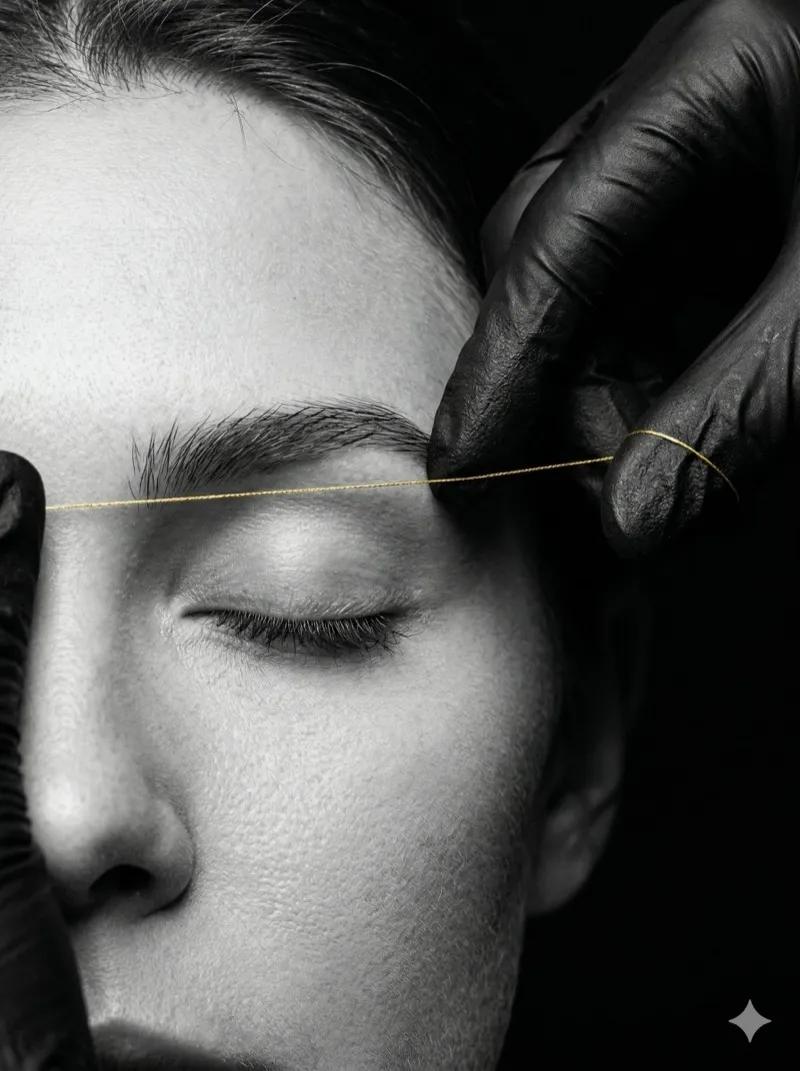
Threading removes hair from the root with a twisted cotton thread; waxing grips the hair and pulls a whole area in one go. Here is how they compare and which one suits you.
Threading removes hair from the root with a twisted cotton thread; waxing grips the hair and pulls a whole area in one go. Both remove hair from the root, but they differ in precision, how much they sting, the areas they work best on and the skin types they suit. In this comparison we go through each method in detail so you can decide which one fits what you need.
With our Unlimited Brows membership (€10/month) you get unlimited brow tidy-ups with wax; brow shaping is not included.
What Is Threading?
Threading has centuries of history in the Middle East and South Asia. It uses a 100% cotton thread, twisted on itself, to catch individual hairs or small groups of hairs and lift them out of the follicle.
Unlike other methods, nothing but the thread touches your skin: no chemicals, no hot resins. That keeps the risk of an allergic reaction to external ingredients to a minimum.
How threading is done
The therapist cuts a length of thread of 30 to 50 cm, ties the ends and twists it several times in the middle to make a kind of "X". By opening and closing the fingers of each hand in turn, the twisted section moves along the skin, catching hairs and pulling them out at the root.
It needs good light and a steady hand. A brow session — see our brow treatments in Gandia — takes around 10-15 minutes; the upper lip, about 5 minutes. We offer it at both salons: brow threading €14, upper lip €8, brows + upper lip €18 and full face €25. It takes practice: control of the thread is what makes the difference between a clean result and an uneven one. Also available at our brow treatments in Ontinyent.
Pros of threading
- Pinpoint precision. It lets you define very exact lines, hair by hair if needed. That is why it is the favourite for brows with a very defined shape. If you prefer wax or tweezers, there is our brow shaping in Gandia and in Ontinyent (€10).
- No chemicals. Cotton thread has no resins, fragrances or preservatives. Ideal if your skin reacts to wax ingredients.
- Suits sensitive and acne-prone skin. With no heat or adhesive on the skin, irritation tends to be lower.
- Gentle exfoliation. The thread also sweeps away surface dead skin, leaving the area a little smoother.
- No risk of burns. There is no heat at any point.
Cons of threading
- Small areas only. It works well on the face (brows, lip, chin, sideburns) but is impractical for large areas such as legs or back.
- Can sting more on coarse hair. Because it pulls hair by hair or in small groups, the tug is repeated many times. On dense hair the session takes longer and the discomfort adds up.
- Depends heavily on skill. Badly done threading can break the hair instead of removing it, cause ingrown hairs or leave an uneven shape.
- Does not catch very short hair. Hair needs to be at least 2-3 mm long for the thread to catch it.
What Is Waxing?
Waxing is probably the most widespread method in beauty salons in Spain. A layer of wax (hot, warm or cold) goes on the skin, grips the hair and, when pulled off, removes it from the root.
There are different types: low-temperature hot wax (the most common in salons for sensitive areas such as the bikini line), warm roll-on wax for legs and arms, and cold wax strips for quick touch-ups. You will find more detail in our complete waxing guide.
How waxing is done
In a professional salon like ours in Gandia and Ontinyent, the therapist first cleanses the area with a pre-wax lotion that removes oil and leftover moisturiser. She then applies the wax in the direction of hair growth and removes it against the growth with a quick, firm movement.
For delicate areas (Brazilian, underarms), low-temperature hot wax is usually used: it sets on the hair without a strip. For legs and arms, warm wax with strips is quicker. A full leg wax takes about 20 minutes; underarms, about 10 minutes.
Pros of waxing
- Fast on large areas. A whole leg is done in minutes compared with any hair-by-hair method.
- Long-lasting results. Because it removes hair from the root, it takes 3 to 5 weeks to grow back visibly, depending on your own growth cycle.
- Gradual weakening. With regular sessions, many people find their hair grows back finer and sparser.
- Works everywhere. Any part of the body: brows, lip, underarms, arms, legs, bikini line, back, chest, buttocks.
- Mechanical exfoliation. Wax lifts dead skin cells, leaving the skin smoother to the touch.
Cons of waxing
- Possible irritation. The pull and contact with the resin can cause redness, especially on very reactive skin. It usually fades within a few hours, but it is worth bearing in mind.
- Risk of burns if the temperature is wrong. In a professional salon this is controlled with adjustable heaters, but it is a real factor.
- Not suitable in some situations. Avoid it on recently sunburnt skin, open wounds, prominent varicose veins or if you use topical retinoids (they leave the skin thinner and more sensitive). Ask a professional if you take medication that affects the skin.
- Needs a minimum length. Hair should be at least 5 mm long (about 10-15 days of growth) for the wax to grip well.
- Possible ingrown hairs. Especially if you do not exfoliate between appointments. Aftercare after waxing is key to preventing them.
Threading vs Waxing: Head to Head
This is where the differences become clear. Point by point:
Effectiveness and how long results last
Both methods remove hair from the root, so results last a similar time: 3 to 5 weeks without visible hair. The difference is consistency: wax catches all the hair in the area in one go, while threading can leave the odd stray hair if the therapist does not go over the area thoroughly. In expert hands, the end result is practically identical.
Over time, both methods weaken the follicle, but wax tends to give a more even weakening on large areas because each pull covers more skin.
Pain and discomfort
This is one of the main worries. The truth is that both sting — pulling hair out by the root is never painless — but the sensation is different:
- Threading: a continuous, repetitive discomfort, like quick pinches. You feel it with every pass of the thread. On small areas such as brows or lip, it is perfectly bearable.
- Waxing: an intense but brief pull with each application. The discomfort is concentrated in an instant and then it is gone.
Pain is very personal. Some people prefer the single pull of wax, others cope better with the tiny pinches of threading. The first session is always the most uncomfortable with any method; from the second, your skin gets used to it.
Which skin types each suits
On sensitive skin, threading has the edge because there is no product or heat. If you are prone to folliculitis or have active acne in the area, threading reduces the risk of spreading bacteria (hot wax can open the pores and let impurities in).
That said, low-temperature wax is formulated for delicate skin and many salons in Gandia and Ontinyent use it successfully on clients with mild rosacea or moderate sensitivity. What matters is telling your therapist about your skin before you start.
Cost and value for money
On brows and lip, threading costs a little more than wax: at our salons, brow threading is €14 compared with €10 for brow shaping with wax or tweezers, and upper lip threading is €8 compared with €6 for an upper lip wax. The real difference shows on large areas: threading legs is not commercially viable (it would take hours), so for those areas wax has no real competition on price or time.
For up-to-date prices on every treatment, see our waxing services page.
Speed
| Area | Threading (approx.) | Waxing (approx.) |
|---|---|---|
| Brows | 10-15 min | 10-15 min |
| Upper lip | 5 min | 5 min |
| Underarms | Not recommended | 10 min |
| Full leg | Not viable | 20 min |
| Brazilian | Not recommended | 15 min |
Wax wins on speed on large areas. On brows and lip the times are similar; threading gives more precision.
Best areas for each method
Threading: the face, and not much else. Brows, upper lip, chin, sideburns, between the brows and cheeks. This is where its precision shines. For brow waxing with a very detailed shape, threading can give exceptional results.
Waxing: head to toe. Brows, lip, underarms, arms, legs, bikini line (Brazilian and Hollywood), back, chest, buttocks, belly line, nose and ears. If you are looking for waxing in Gandia or Ontinyent, at Adrian Beauty Studio we do all these areas. You can see the full list on our Gandia salon and Ontinyent salon pages. Also available: waxing in Ontinyent.
Which Should You Choose?
There is no method that is better for everyone. It depends on the area, your skin type, your priorities and how much discomfort you tolerate.
Choose threading if...
- You want maximum precision on your brows or lip.
- Your skin reacts to cosmetic ingredients (resins, fragrances).
- You have active acne in the area and want to keep contact with the skin to a minimum.
- You prefer a 100% chemical-free method.
- You only need small facial areas done.
Choose waxing if...
- You want large areas done (legs, arms, back, bikini line).
- Speed matters to you: one session can cover several areas in under an hour.
- You are not hypersensitive to wax ingredients.
- You want the hair to weaken gradually over the long term.
- You prefer one intense but brief pull to lots of small repeated ones.
If you want to compare wax with more high-tech methods, have a look at our waxing vs laser comparison for the full picture.
Special considerations by skin type
Sensitive skin. Both methods work, but threading irritates less on the face. If you go for wax, ask for low-temperature wax and apply fragrance-free aloe vera gel straight afterwards.
Oily or acne-prone skin. Take care with hot wax: opening the pores can encourage infection in inflamed follicles. Threading is safer on these facial areas. Either way, cleanse the area before and after with an alcohol-free toner.
Dry skin. Wax takes some of the skin's natural moisture with it. Moisturise well in the days before and step up hydration after the session. Threading barely affects moisture levels.
Skin with rosacea or broken capillaries. Avoid hot wax on the affected areas (heat dilates the capillaries). Threading can be a gentler option, but check with a dermatologist first if your rosacea is severe.
Skin prone to marks (post-inflammatory pigmentation). Both methods can cause marks if the area becomes very inflamed. Use SPF 50 for the following days and avoid direct sun for the first 24-48 hours.
Threading vs Waxing: FAQ
Which lasts longer, threading or waxing?
Results last a very similar time with both: 3 to 5 weeks, because both remove hair from the root. The difference depends more on how fast your hair grows than on the method. Some people see regrowth at 2 weeks; others go 6 weeks without visible hair. With regular sessions, both methods tend to stretch the time between appointments because they weaken the follicle.
Which hurts more, threading or waxing?
The sensation is different, not necessarily stronger or weaker. Threading gives continuous tiny pinches while the therapist works; wax gives a strong but brief pull with each application. At the first session, wax often feels more intense because of the impact of the pull, but the discomfort lasts an instant. Threading spreads it out over more time. From the second or third session, the pain usually drops noticeably with both methods. If you have a low pain threshold, ask your therapist about applying a soothing cream beforehand.
Which is better for sensitive skin, threading or waxing?
Generally, threading irritates less because no product or heat touches the skin. It is a good choice if you have contact dermatitis, a resin allergy or active acne on the face. That said, low-temperature wax for sensitive skin (rosin-free, hypoallergenic) gives excellent results in most cases. The key is to tell your therapist about any skin condition before the session. At our Gandia and Ontinyent salons we always do a quick skin check before starting.
Which is cheaper, threading or waxing?
On the face, threading costs a little more: at our salons, brow threading is €14 (€10 for brow shaping with wax or tweezers), upper lip threading €8 (€6 with wax), brows + upper lip threading €18 and full face threading €25. The real difference comes with large areas: wax is the viable option for legs, arms, back or bikini line, while threading is not offered for those areas because of the time it would take. You can check up-to-date prices on our waxing services page. In general, wax is hard to beat on value for body waxing.
Can I have threading if my hair is very dark?
Yes, no problem at all. Hair colour does not affect threading: the thread catches the hair mechanically, whether it is blonde, brown or black. In fact, dark and slightly coarse hair is often easier to catch with the thread than very fine hair. What can vary is the discomfort: coarser hair resists more as it comes out, so you feel it a little more. Wax also works well on dark hair, so the choice depends more on the area and your skin type than on hair colour.
Which is better for brows, threading or waxing?
Brows are where threading shines. The thread defines arches with a precision that wax alone does not always match. Still, many therapists combine wax (to remove the coarser hair from the larger areas) with tweezers or thread (to refine the final line). This mixed approach is common in professional salons. For more on shaping brows to suit your face, see our guide to brow waxing. In practice, a good therapist gets flawless results with either method.
Can threading be done anywhere on the body?
Technically yes, but in practice it is only efficient on small areas of the face: brows, upper lip, chin, sideburns, between the brows and cheeks. Threading legs, arms, underarms or the bikini line would take far too long and hurt more than other methods. For large body areas, wax is the standard for speed and results. If you need a full-body wax, at Adrian Beauty Studio we offer waxing for every area, at both our Gandia and Ontinyent salons.
What aftercare do I need after threading or waxing?
Aftercare is similar for both, with small differences. For the first 24 hours, avoid direct sun, saunas, chlorinated pools and products with acids or retinol on the area. Apply pure aloe vera gel or a fragrance-free soothing cream to reduce redness. From day three, start gently exfoliating (a mild scrub, nothing harsh) twice a week to prevent ingrown hairs. Moisturise daily. If you have been waxed, avoid very tight clothing for the first few hours on areas such as the bikini line or underarms. You will find a detailed routine in our guide to aftercare after waxing.
If you are still not sure which method suits your skin or the area you want done, the best thing is to ask a therapist. At Adrian Beauty Studio, at both our Gandia salon and our Ontinyent salon, we look at your skin and hair before recommending a method. You can book online and we will answer your questions in person.
Quick reference: waxing
| Area | Session | Results last | Pain (1-5) |
|---|---|---|---|
| Bikini line | 10-15 min | 3-5 weeks | 3-4 |
| Underarms | 10 min | 3-4 weeks | 3 |
| Half leg | 15 min | 3-5 weeks | 2-3 |
| Upper lip | 5 min | 2-3 weeks | 3 |
| Brows | 10 min | 3-4 weeks | 2-3 |
| Back | 25 min | 4-5 weeks | 3 |